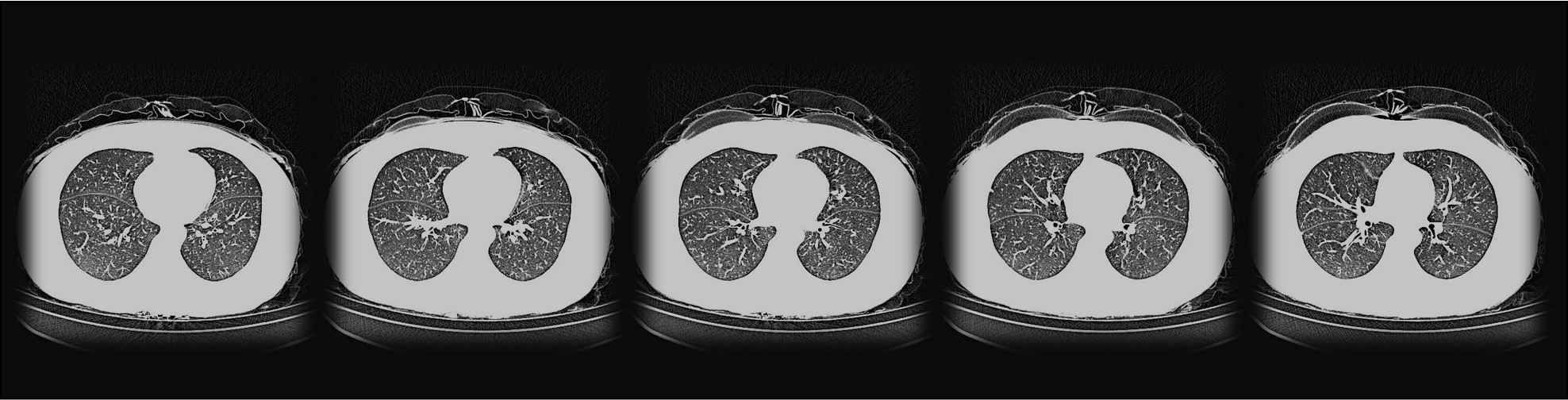
A chest CT dataset with Chinese findings and conclusions
368 COVID-19 chest CT studies and 3,680 axial slices, each paired with the
original free-text radiology report written in Chinese by the reporting radiologist.
Guangyi Liu, Yinghong Liao, Fuyu Wang, Bin Zhang, Lu Zhang, Xiaodan Liang,
Xiang Wan, Shaolin Li, Zhen Li, Shuixing Zhang, Shuguang Cui SRIBD · FNii ·
CUHKSZ-JD Joint AI Lab ·
CUHK-Shenzhen
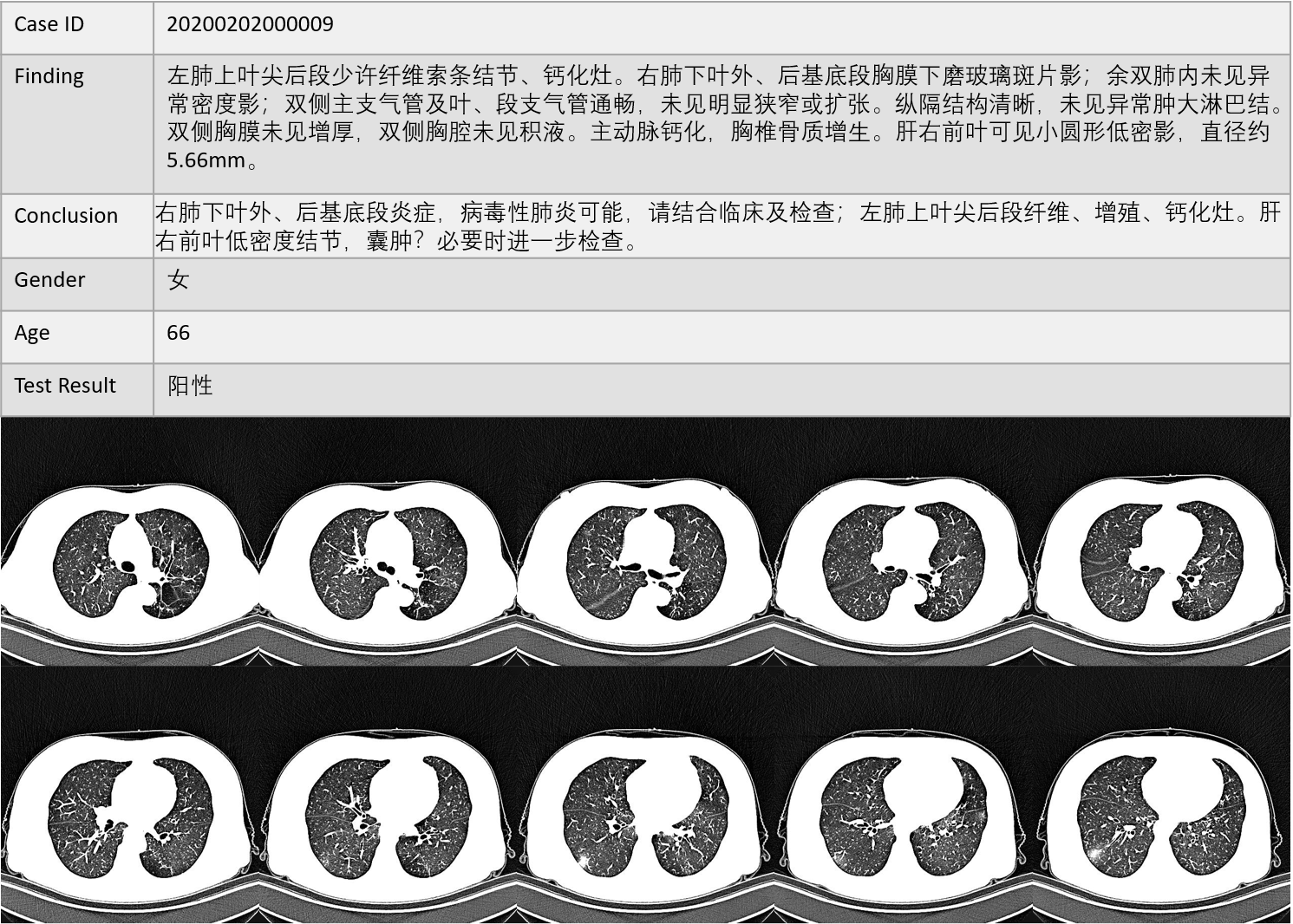
Each row is one CT examination: ten axial lung-window slices, plus the
radiologist's findings and conclusion exactly as written, plus sex, age and the
RT-PCR result. The reports are not translated and not reduced to labels — they are the raw
clinical text, with incidental findings, negative statements about unrelated organs, hedging,
and comparisons against the patient's previous scan.
One row of the dataset — ten axial slices of a single examination with the
radiologist's findings and conclusion.
What the data looks like
Both charts below count studies (examinations), not patients: because patients were
re-scanned every few days, the 368 studies come from roughly 96 people.
Age and sex
Studies per ten-year band
FemaleMale
Show as table
Examinations over time
Studies per week, weeks beginning Monday, 18 Jan – 8 Mar 2020
Show as table
⚠ Do not split this dataset randomly
77% of the reports compare against an earlier scan of the same patient
(对比2020-02-08CT检查, 较前吸收), and consecutive studies of one patient have
near-duplicate reports. A random study-level split puts a patient on both sides of the
train/test boundary and inflates report-generation scores.
Per-study patient identity was not preserved with the data and is no longer recoverable.
The release therefore ships patient_block — 67 (sex, age) cells
that are guaranteed to contain every study of a given patient — and a
recommended_split built from whole blocks, so no patient can straddle the
boundary. Use it, or group by patient_block yourself.
Recommended split
Split
Studies
Blocks
Female
Male
Age range
Mean age
train
296
43
160
136
3–75
46.8
validation
35
12
15
20
16–71
49.8
test
37
12
21
16
20–80
51.7
This split is for
leakage-free benchmarking and is not the split used in the TNNLS paper, so results are
not directly comparable to the published numbers. The paper also used 3 slices per study;
this release provides all 10.
Getting the data
The dataset is hosted on the Hugging Face Hub. Access is gated: the dataset card is
public, the files are released once you accept the data use terms. This replaces the old
arrangement of emailing a signed confidentiality agreement.
Request access. Fill in your name, institutional email, affiliation and intended
use, and accept the terms: non-commercial research only, no re-identification, no
redistribution, no clinical use.
Load it once the request is approved.
from datasets import load_dataset

ds = load_dataset("guangyil/COVID-19-CT-Chinese", split="train")

ex = ds[0]
print(ex["case_uid"], ex["sex"], ex["age"], ex["rt_pcr"])
print(ex["findings_zh"])      # 检查所见
print(ex["conclusion_zh"])    # 诊断意见
ex["images"][0].show()        # 10 axial slices, PIL images

# use the leakage-free split — do not split randomly
train = ds.filter(lambda x: x["recommended_split"] == "train")
test  = ds.filter(lambda x: x["recommended_split"] == "test")
Terms, in short
Released under CC BY-NC-SA
4.0 — attribution, non-commercial, share-alike. On top of the licence you agree not to
re-identify anyone, not to redistribute the data (point people here instead), and not to use
the data or any model trained on it for clinical decision-making. The full terms are on the
dataset card.
What is not included
The Chinese medical encyclopedia corpus used for the knowledge-pretraining stage of
Medical-VLBERT is not redistributed: it was scraped from third-party medical websites and is
not ours to relicense. It is not needed to use this dataset. The chest X-ray dataset CX-CHR,
also used in the paper, is a third-party dataset and is likewise not distributed here.
Citation
If you use this dataset, please cite:
@article{liu2021medicalvlbert,
  title   = {Medical-VLBERT: Medical Visual Language BERT for COVID-19 CT
             Report Generation With Alternate Learning},
  author  = {Liu, Guangyi and Liao, Yinghong and Wang, Fuyu and Zhang, Bin and
             Zhang, Lu and Liang, Xiaodan and Wan, Xiang and Li, Shaolin and
             Li, Zhen and Zhang, Shuixing and Cui, Shuguang},
  journal = {IEEE Transactions on Neural Networks and Learning Systems},
  volume  = {32},
  number  = {9},
  pages   = {3786--3797},
  year    = {2021},
  doi     = {10.1109/TNNLS.2021.3099165}
}